Are you looking for a Community Shared Agriculture (CSA) farm near you?
I (Duncan) often hear from friends that it is difficult to locate CSA farms and local food in Canada. Since I have trouble accepting these remarks, I did a few web searches, asked our community on Facebook and Twitter, and sent some emails to friends to see if this was true. Here are the regional Canadian CSA lists I found:
2015 CSA Farm List (Nova Scotia) Adventures in Local Food Blog, Food Action Committee, Ecology Action Centre
Atlantic Farm Share Network (Organic Only)
Alberta CSA Farms
Community Support Agriculture: Ontario Directory
CSA Farms British Colombia- Farm Folk City Folk
Etomami Community Organic Farm (Saskatchewan- only one I could find)
We received significant community feedback about the “Products” (formerly called “add-on’s”) and “Customers” management areas in HarvestHand. This month we have focused our efforts on improving inventory management and customer organization.
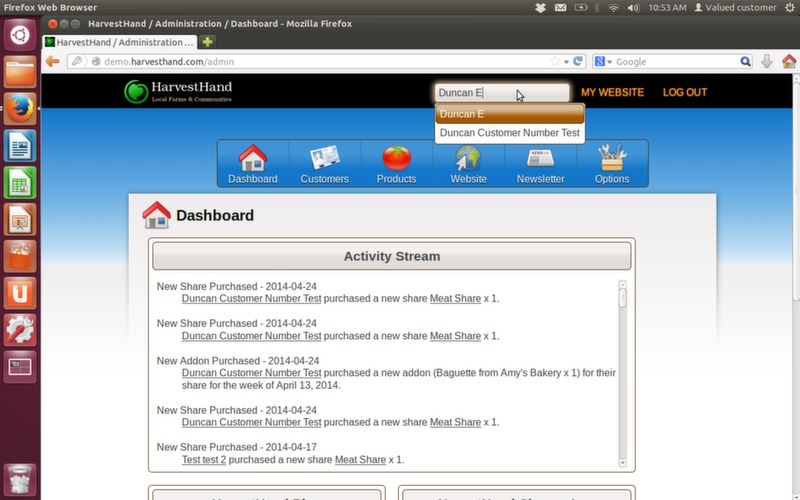
Customer Search
Quickly find/jump to a customer from any page section of the back end of HarvestHand. Start typing a customer name, then use keyboard "up" and "down" arrows and hit "enter" to select customer.
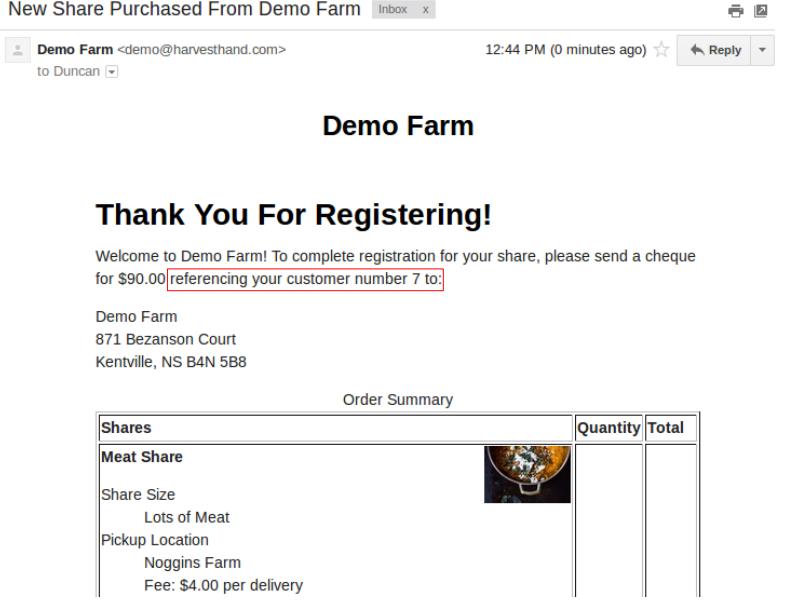
Customer Reference Number
A customer reference number is auto-generated and shown to customer when they are logged in and in relationship to payments. These can be used to reference cheques and bank payments. This was added because customer reference numbers are useful for keeping track of payments and because Strawberry Hill Farm is testing auto-bank payments.
Setting up your farm as payee has some challenges, read about Tim’s experience.
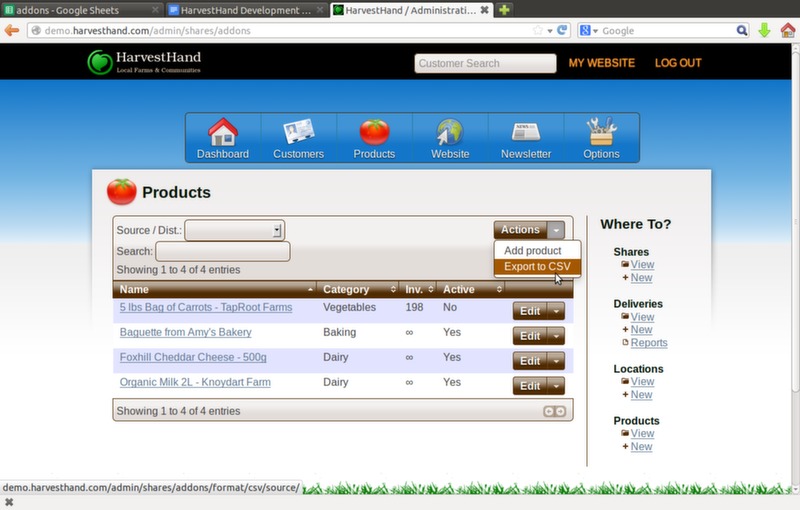
Export Products
Products can now be exported from a CSV/excel file. This enables further analysis product inventory.
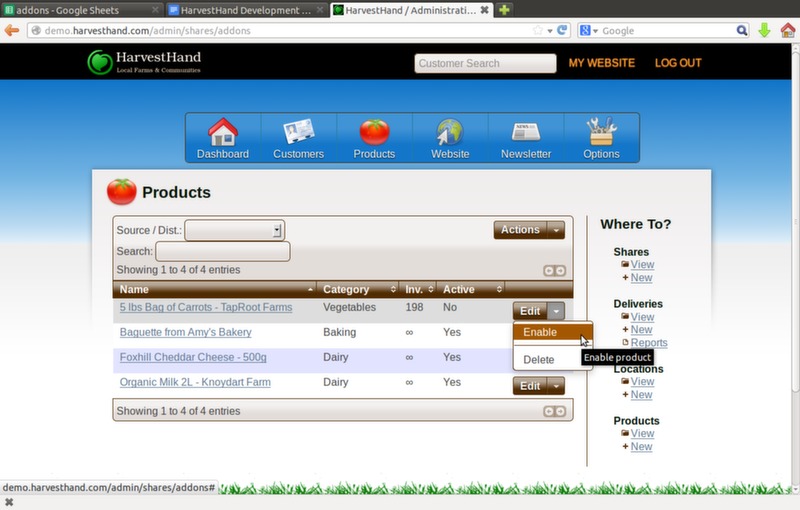
Products Management Update
You can now make changes to the product enabled status and expiration without needing to enter each individual product.
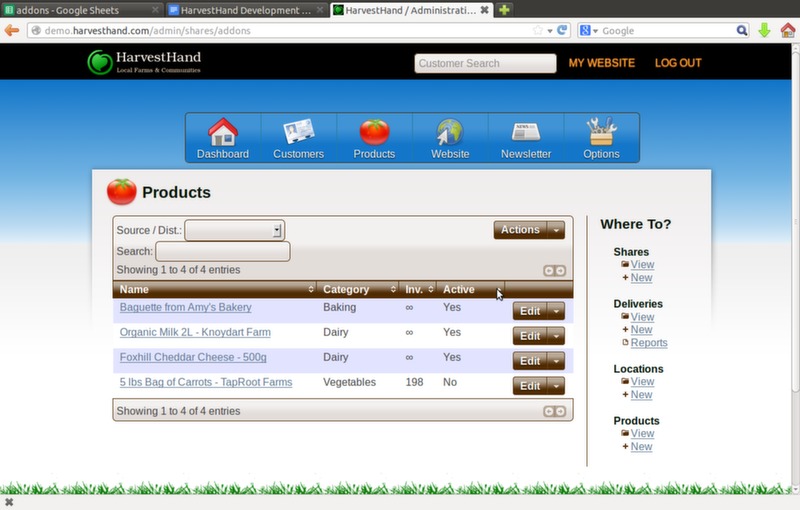
Sort Products by Active
Sort your products list by “active” products. Ie. products currently available for sale.
We make customer management, e-commerce, marketing easy for food and farm communities. Learn aboutHarvestHand Platform
Join Dr. Thierry Vrain, retired genetic engineer who after a 30 year career with Agriculture Canada now speaks out against genetically-engineered technology. Mr. Tony Mitra, an international active citizen journalist, and food security activist, to discuss concerns about GE-GMO food, and how you can take action.
From the Halifax Media Co-op interview:
"My main message for the people in Nova Scotia is that 80 per cent of the food in the grocery store is contaminated with engineered ingredients," says Vrain. "Soy beans, canola, corn, cotton seed oil, sugar beets. Those crops, engineered to be tolerant of herbicides are then sprayed with [herbicides like] Round Up." Read more...
Cross-Canada Speakers Tour Events
Acadia University KC Irving Centre Auditorium, Saturday April 26th at 3pm, Wolfville, Nova Scotia
Tatamagouche Centre, Sunday April 27th at 7pm, Tatamagouche, Nova Scotia
St. Ninian Place, Monday April 28th at 7pm, Antigonish, Nova Scotia
Murphy’s Community Centre, Tuesday April 29th at 7pm, Charlottetown, PEI
Trinity United Church, 90 Spring St., Wednesday, April 30 at 7pm, Summerside, PEI
Can't make the talk?
Watch Dr. Vrain's GE-Food talk in Salmon Arm, BC, on Youtube
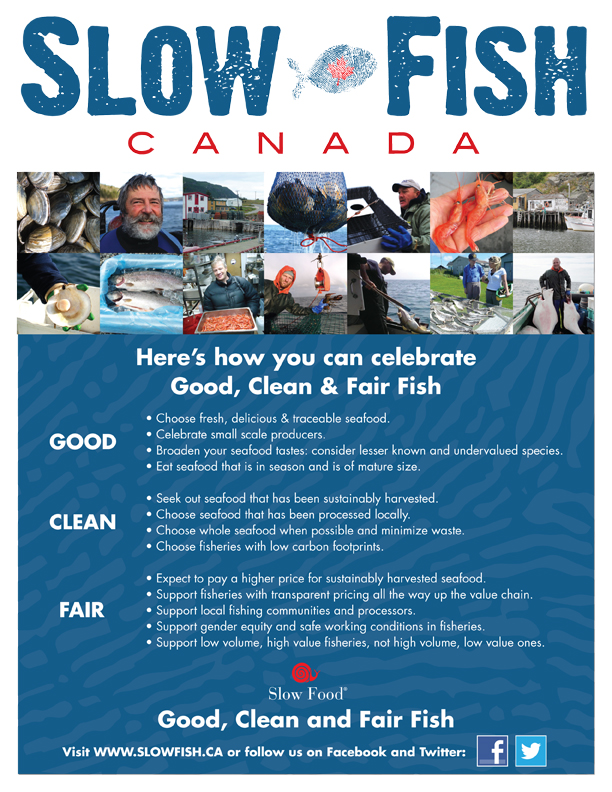
Slow Fish Canada has launched a campaign to invite people to find local solutions that support a better management of our freshwater and marine resources. Dave Adler, Coordinator of Off the Hook Community Share Fishery (CSK), a member of the Marine team at the Ecology Action Centre Halifax, and a inspirational contributor to HarvestHand is a key leader in global Slow Fish movement.
The key issues for Slow Fish include addressing and bring awareness to the dwindling state of global fish stocks, pollution of the oceans and its impact on the livelihood of small-scale fishing communities.
Press Release: Slow Food Canada Launches the Slow Fish Canada Campaign
Canada-Slow Food Canada is excited to announce the creation of the Slow Fish Canada campaign, a national group that will focus efforts on issues related to fisheries. During the 2013 Annual General Meeting, held last April in Osoyoos, BC, the membership voted unanimously for the creation of the national campaign.
Fishing is a particularly critical issue, given the dwindling state of global fish stocks, pollution of the oceans and its impact on the livelihood of small-scale fishing communities. By engaging the entire Canadian Slow Food network, the Slow Fish Canada campaign will invite people to find local solutions that support a better management of our freshwater and marine resources.
The Slow Food approach is based on three tenets: food that is good, clean; fair; says Dave Adler of Nova Scotia's Ecology Action Centre. The same is true of Slow Fish. We hope to support, discover, and celebrate Canada's small scale, sustainable fisheries by connecting people who eat seafood to the people who catch it, harvest it, and grow it.
Building on Slow Fish International[1] the Slow Fish Canada campaign will focus primarily on promoting artisanal fishing and neglected fish species. The campaign will also address issues such as access to good, clean and fair fish for consumers; fair remuneration and access to regional markets for small-scale producers; social finance and succession planning for fisheries; fair access to quotas by independent owner-operator fishing enterprises; and support of new and developing fisheries. Slow Fish Canada also plans to develop awareness campaigns around important issues such as aquaculture and eco-certification of seafood. Slow Fish Canada will raise awareness around salmon conservation by building on the Wild Salmon Manifesto, which was adopted by Slow Food Canada in 2006.
Slow Food Canada has been active in different regions of the country for more than 10 years, with a particularly strong presence in the Maritimes, Montreal, Ontario and British Columbia. Today, more than thirteen hundred members belong to thirty convivia that span the country from Newfoundland and Cape Breton Island to Vancouver Island and Whitehorse in the Yukon.
Slow Fish Canada Campaign
David Adler
dadler[at]ecologyaction.ca
(902) 442-0999
Slow Food Canada- General Inquiries
Valerie Lugonja
valerie[at] acanadianfoodie.com
(780) 709-7902
[1] Slow Fish is an international campaign launched by Slow Food International to promote good, clean and fair fish by informing consumers and encouraging interaction between those involved in the world of sustainable fisheries. For more information, please visit: www.slowfood.it/slowfish/
The Community Shared Agriculture (CSA) model of growing and distributing food aims to engage members in all aspects of farming. Philosophically and practically this means that risk and and reward are shared between members and farmers. As it is difficult to predict “the weather” when it comes to growing food and building relationships, proactively addressing legal concerns is imperative. Please note that these resources are for informational purposely only and are not legal counsel. Always consult an attorney regarding specific situations.
Types of CSA Legal Agreements
CSA Membership Agreement
This agreement protects the individual rights of the member and farmer/farm and clearly communicates relationship expectations moving for. Membership agreements include an agreement overview, what is expected from the member and the farm, farm growing practices (anything from certification to harvesting times), expected products, share commitments (what happens in the event of crop failure or surplus), share/box pickup terms, membership fees, and communication practices. Download a template the FarmCommons.org CSA Membership Agreement Template
Worker Share Agreement
As a farm, you may choose to accept farm work in exchange for membership fees or, alternatively, make it obligatory for members to volunteer on the farm. This agreement outlines the worker share's obligations, farm's obligations, type of worker share's service, worker share's risk of working, release of claims and assumption of risk, medical care authorization, and signature. There are many differences between volunteer and employee worker share agreements, make sure to consult your region's labour laws. Download the FarmCommons.org Worker Share Agreements Guide
Volunteer Liability Waiver
This waiver form releases farms from potential liability of volunteer injuries on farm property. While many farms choose to disregard volunteer agreements because they only work with volunteers they trust, depending on your state/province laws and insurance practices, it may be the individual's health insurance company who chooses to sue your farm, so it can't hurt to have one of these. Download the FarmCommons.org Volunteer Liability Guide
Adding Your Membership Agreement in HarvestHand
After logging into HarvestHand, click on Options>Share Options and type or copy your membership agreement into the Payment Options and Plans>Terms
Your membership agreement will appear automatically when a potential member chooses to purchase a share.
CSA Membership Agreement Resources
FarmCommons.org for sample CSA membership agreements, worker share agreements, and volunteer agreements

 Join Dr. Thierry Vrain, retired genetic engineer who after a 30 year career with Agriculture Canada now speaks out against genetically-engineered technology. Mr. Tony Mitra, an international active citizen journalist, and food security activist, to discuss concerns about GE-GMO food, and how you can take action.